The Invisible Real Estate: Why the Next Generation of Stadium Revenue Belongs to the Network
By Weaver Labs
Sports venues often struggle with advanced digital applications because rigid, legacy network hardware cannot handle peak fan demand.
To solve this, stadiums must adopt an open, software-defined network infrastructure that seamlessly integrates fragmented data silos. By transforming connectivity into agile digital real estate, venues can unlock greater operational efficiency, data sovereignty, and significant new revenue streams.
For the past decade, live sports venues have actively explored the potential opportunities of digital transformation. To capture the attention of a mobile-first generation, clubs have deployed a vast array of engaging applications including independent applications -from real-time multi-camera streaming and augmented reality fan zones to biometric ticket gating and dynamic in-seat concession ordering.
On the surface, this strategy works. Individually, these applications represent the pinnacle of modern fan engagement. But when tens of thousands of fans fill a stadium, a predictable, invisible crisis unfolds. The local network infrastructure, built on rigid, hardware-centric legacy systems, struggles to meet the volume and differing demands of the event under peak demand. Those applications that once spiked the engagement start to stall, latency spikes, and the fan experience fractures.
The industry does not have an “app problem” -stadiums are buying exactly the right software tools. It has an architectural translation problem. To unlock the full commercial and experiential value of these technologies, sports organisations must pivot from managing static hardware to adopting an open, software-defined network infrastructure.
The Infrastructure-App Paradox: Bridging the “Translation Gap”
The commercial reality facing sports venues today is one of sharp contrasts. Industry data from PTI Digital’s Making Sense of Data report reveals that while two-thirds of venue leaders recognise integrated data is critical for commercial growth, 50% of sports organisations are commercialising less than 10% of their known user databases.
The issue isn’t a lack of fan data; it is that the data is trapped inside fragmented silos. A premium ticket app, an AI-powered crowd flow monitor, and a contactless point-of-sale system all speak different digital languages. When these tools cannot communicate in real time, venues operate in the dark, unable to map a holistic fan journey.
To fix this, the sports industry needs a flexible middleware layer -a network orchestration framework that abstracts complex underlying hardware into an agile, open platform. This architecture creates a common translation engine, turning raw data into an active asset.
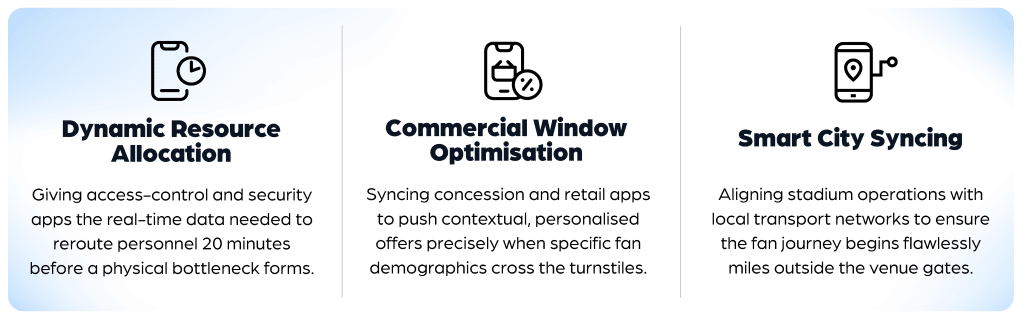
Take fan arrival behaviour as a prime example. Insights from the Barça Innovation Hub demonstrate that crowd arrival metrics are highly predictable, formatting distinct patterns up to 72 hours before kickoff. When a stadium treats its underlying connectivity as an open, software-driven ecosystem, it can feed these predictive crowd flows directly into its application matrix:
Network-as-a-Service: Turning Sunk Costs into Digital Real Estate
To sustainably support this high-tech vision, sports organisations must change how they view telecom infrastructure. Traditionally, high-density connectivity (like Wi-Fi or Distributed Antenna Systems) has been treated by finance departments as a heavy, sunk capital expenditure or a generic back-office utility.
By shifting toward a Network-as-a-Service (NaaS) model powered by programmable, private 5G and integrated edge computing, venues can transform connectivity into prime digital real estate. Instead of relying entirely on monolithic mobile network operators, stadiums can independently host, scale, and monetise their own network ecosystem.
This software-first framework unlocks entirely new, non-commercialised revenue streams:
Sovereign Data Ownership: By running an autonomous edge cloud natively inside the venue blueprint, stadiums retain absolute ownership of their network data analytics. They no longer surrender valuable behavioral insights to external carriers, preserving user compliance while building a rich, sovereign data foundation.
Dynamic Network Slicing: Operators can use software to partition a single physical network into secure, virtual “slices.” Crucial operational streams -like broadcast feeds, ticketing gates, and emergency services- can be completely isolated and guaranteed 100% uptime, while fan-facing apps share a separate high-speed pool.
Infrastructure Multi-Tenancy: A software-defined network acts as an open infrastructure marketplace. Third-party tenants, commercial sponsors, and external developers can securely deploy their applications directly onto the stadium’s edge cloud on demand, multiplying network utility and creating zero-friction business models.
Real-World Proof: The Trial at Stadium MK
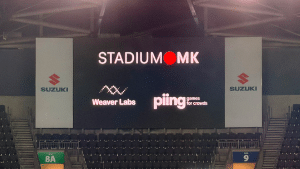
This infrastructure-first approach isn’t theoretical; it has been validated under intense, real-world match-day conditions. At Stadium MK, several live trials demonstrated how software orchestration could solve the high-density connectivity crisis without requiring a complete hardware overhaul.
By utilising an open network architecture like Cell-Stack, developed by Weaver Labs, the venue seamlessly married its physical infrastructure with an intelligent private 5G network. Rather than forcing the stadium to choose between competing proprietary systems, this open-network approach acted as a neutral foundation. It allowed a variety of advanced, third-party applications to run simultaneously at the edge with ultra-low latency.
During the trial, the stadium successfully delivered synchronised, multi-angle live video streams directly to fans’ devices, powered real-time AI match analytics, and hosted 3D smart navigation tools to optimise crowd routing. To prevent the standard match-day “signal blackout,” the underlying software automatically optimised network traffic based on live stadium spikes, ensuring the fan experience never stuttered.
The economic implications of this shift are profound. Independent economic evaluations of this software-defined model project an increase in five-year Net Present Value (NPV) from £16.8 million to £52.1 million for a typical stadium ecosystem. This massive jump stems directly from drastically reduced deployment times, lower structural costs, and the agility to activate new digital services in days rather than months.
The New Playbook for Stadium Operators
The true measure of a next-generation stadium lies in the intelligence of its supporting network, far outweighing the sheer volume of digital apps it introduces to fans. When sports venues break free from rigid, hardware-heavy telecom models and embrace open, software-orchestrated networks, they gain the agility to scale on demand.
By mastering the underlying digital infrastructure, sports organisations can protect their software investments, retain absolute sovereignty over their data, and turn match-day connectivity into an agile, revenue-generating engine.
The live entertainment industry has reached a point where the physical experience on the field or stage is only half the story. The other half happens in another reality that is becoming embedded in everything we do –the screens in the palm of every spectator’s hand. Fans expect to interact with the event –whether that […]
This article marks the conclusion of our series on the digital evolution of modern venues where we shift from identifying the problem to executing the solution. If our previous articles established that technology is no longer a utility but a strategic asset, and that infrastructure is the engine of ROI, this final piece outlines the […]
In the second part of our three-part series, we move beyond connectivity as an asset to explore the ‘Translation Gap’; the critical divide between collecting stadium data and converting it into commercial fuel. In our previous discussion, we addressed the “Shiny Object” trap; the tendency to prioritise high-tier applications over the foundational infrastructure required to […]
This is the first in a three-part series exploring why connectivity has evolved from a back-office utility into a stadium’s most powerful commercial engine. In the modern sports and entertainment landscape, the pursuit of innovation is relentless. Stadium operators are under immense pressure to deliver the “stadium of the future,” leading to significant investments in […]
At Weaver Labs, we believe a truly smart stadium isn’t defined by cables, antennas, or signal bars; it’s defined by what connectivity enables. A smart venue is one where digital infrastructure acts as a platform, allowing immersive experiences, real-time interaction, and innovative ways for fans to engage with the matchday experience. On February 17th, we […]
DePIN (Decentralised Physical Infrastructure Networks) is often discussed in abstract terms, wrapped in crypto narratives and future promises. But stripped of hype, DePIN describes a very real architectural and economic shift: turning physical infrastructure into shared, programmable, value-generating platforms. For stadiums under pressure to improve fan experience, unlock new revenue streams, and operate more efficiently, […]