The Leadership Mandate: 5 Pillars of the Revenue-Driven Stadium
By Weaver Labs
This article marks the conclusion of our series on the digital evolution of modern venues where we shift from identifying the problem to executing the solution. If our previous articles established that technology is no longer a utility but a strategic asset, and that infrastructure is the engine of ROI, this final piece outlines the roadmap for leadership to bridge the gap between data and money.
As the industry moves from an analogue past to a digital-first future, the primary challenge remains the “Translation Gap.”
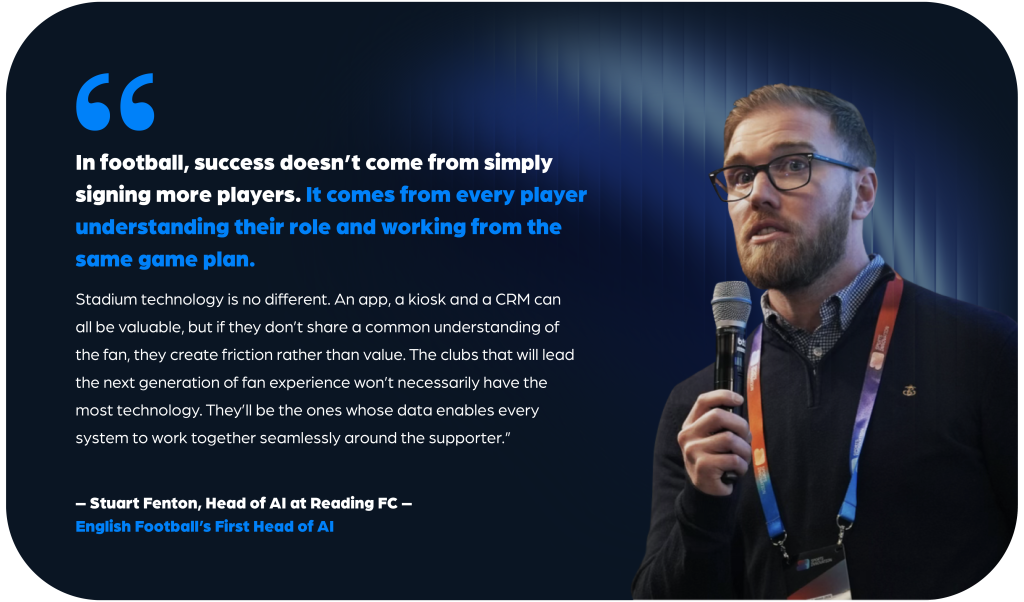
“True leadership in the sports industry isn’t about chasing the next shiny object; it’s about having the courage to fix the foundation. We are moving into an era where the most successful clubs won’t be defined by the apps they buy, but by how effectively they command their own data to serve the fan.”
– Maria Lema, CEO at Weaver Labs
The industry often falls into the trap of treating symptoms rather than causes. A stadium might see a dip in mid-game concessions revenue and respond by purchasing a new mobile ordering app. While the app is “shiny,” it doesn’t solve the underlying issue: a lack of orchestrated intelligence.
According to the PTI “Making Sense of Data” report, 50% of sports organisations are commercialising just 10% or less of their database. This isn’t a failure of effort; it’s a failure of architecture. To move from “data-heavy” to “revenue-driven”, leadership must master these five pillars:
1. Eradicate Data Debt
Many stadiums are still tethered to decades of disorganised data and obsolete business models. To successfully implement advanced technology like AI, you must first secure your foundation. Data is the heartbeat of every interaction across your organisation, it must be accurate, organised, and ready to perform.
2. Move from Product to Outcome
Focus should move from buying apps to buying outcomes. If you don’t know who is in the seat, how they arrived, and what their historical preferences are, you are merely layering new tools over old blind spots. Success is no longer about the physical items you own, but about how you orchestrate services to ensure the fan gets exactly what they want, when they want it.
3. Bridge the Digital Islands
The value of your ecosystem isn’t found in a single application; it is found in the intersections. The combination of purchasing history, real-time location, and digital engagement is where new commercial opportunities are born. Without a unified framework to bridge these silos, your “shiny apps” remain isolated cost centers.
4. Transition to Predictive Intelligence
As highlighted by the Barça Innovation Hub, fans do not arrive or consume randomly; their behavior follows patterns that can be modeled 72 hours before kickoff. This embedded intelligence can turn raw entry flows into strategic advantages, aligning staffing, retail, and sponsorship triggers with the exact moments fans are ready to engage.
5. Prioritise the Orchestration Layer
The “Stadium of the Future” is a platform, not a building. This requires a shift toward an orchestration layer, a foundational architecture that allows decentralised tools to speak a common language. This is where Cell-Stack by Weaver Labs enters the conversation. It provides the unified framework that ensures your data is contextualised, integrated, and ready to drive the P&L.
The Bottom Line: Intelligence is the Only Moat
In 2026, the question is no longer “do we need data?” but “how fast can we translate data into money?”
The chasm between Tier 1 organisations and the rest of the market is widening. The teams that thrive won’t just be data-driven, they will be outcome-driven through orchestrated intelligence.
Are you ready to stop managing gadgets and start mastering the fan experience? The strategy starts with the foundation. Book a consultation with Weaver Labs today to learn how we provide the architecture for the next generation of stadium excellence: [email protected]
In the second part of our three-part series, we move beyond connectivity as an asset to explore the ‘Translation Gap’; the critical divide between collecting stadium data and converting it into commercial fuel. In our previous discussion, we addressed the “Shiny Object” trap; the tendency to prioritise high-tier applications over the foundational infrastructure required to […]
This is the first in a three-part series exploring why connectivity has evolved from a back-office utility into a stadium’s most powerful commercial engine. In the modern sports and entertainment landscape, the pursuit of innovation is relentless. Stadium operators are under immense pressure to deliver the “stadium of the future,” leading to significant investments in […]
At Weaver Labs, we believe a truly smart stadium isn’t defined by cables, antennas, or signal bars; it’s defined by what connectivity enables. A smart venue is one where digital infrastructure acts as a platform, allowing immersive experiences, real-time interaction, and innovative ways for fans to engage with the matchday experience. On February 17th, we […]
DePIN (Decentralised Physical Infrastructure Networks) is often discussed in abstract terms, wrapped in crypto narratives and future promises. But stripped of hype, DePIN describes a very real architectural and economic shift: turning physical infrastructure into shared, programmable, value-generating platforms. For stadiums under pressure to improve fan experience, unlock new revenue streams, and operate more efficiently, […]
At Weaver Labs, our mission has always been to make connectivity more open, programmable, and intelligent. And now, that mission is accelerating into its next chapter. Today, we’re officially announcing our strategic partnership with Madevo AI. A collaboration that has been quietly maturing behind the scenes and is now ready to redefine what’s possible in […]
Last week, the JOINER (Joint Open Infrastructure for Networks Research) Platform, a project we’re proud to contribute to, won the National AI Award 2025 in the High Tech & Telecom category. For us at Weaver Labs, this recognition means more than a trophy on a shelf. It’s proof that the future we’ve been building toward […]