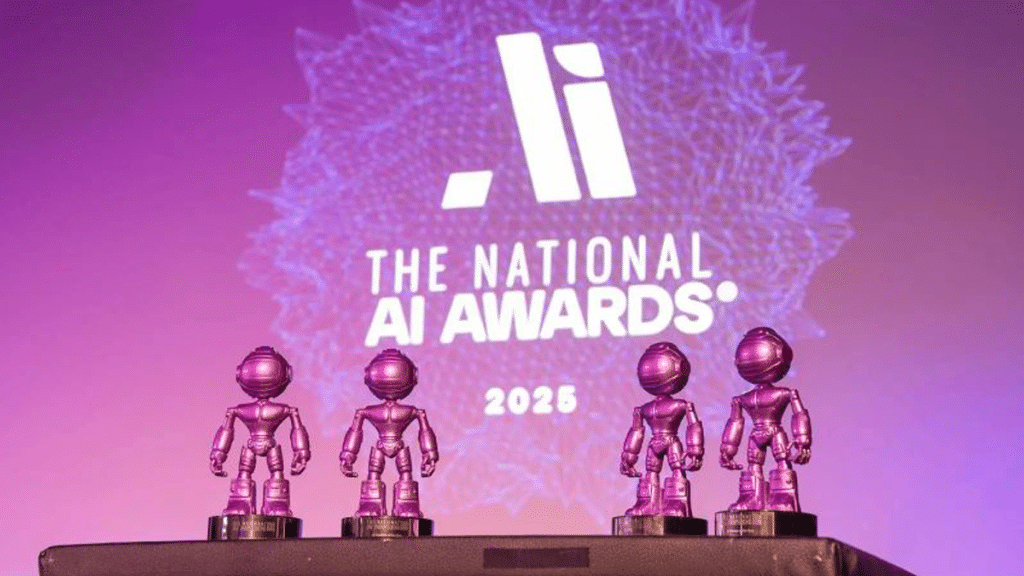
Last week, the JOINER (Joint Open Infrastructure for Networks Research) Platform, a project we’re proud to contribute to, won the National AI Award 2025 in the High Tech & Telecom category.
For us at Weaver Labs, this recognition means more than a trophy on a shelf. It’s proof that the future we’ve been building toward is already taking shape — one where telecom networks are open, automated, and built for collaboration.
Building the Foundations for AI-Driven Connectivity
Telecom is changing fast. Networks aren’t just getting faster; they’re getting smarter. Artificial intelligence is no longer something that sits on top of the network; it’s becoming part of the network itself.
That shift is why AI matters. For decades, telecom innovation has been limited by rigid infrastructure, siloed systems, and centralised cloud dependencies that made experimentation slow and expensive. AI has the power to change that — but only if the infrastructure beneath it is flexible, distributed, and programmable.
That’s where JOINER comes in.
Led by the University of Bristol’s Smart Internet Lab, JOINER brings together universities, industry, and government in a large national consortium. Together, we are building the UK’s first open platform for next-generation network research — a living testbed that allows new ideas to be tested, shared, and scaled across 11 interconnected sites nationwide.
And inside that platform, our technology — Cell-Stack — plays a vital role.
Our Contribution: Hypervisor as a Service (HaaS)
Within JOINER, Weaver Labs provides the automation and orchestration layer that keeps everything running smoothly. Through our Cell-Stack software, we deliver Hypervisor as a Service (HaaS) — an automation capability that simplifies how researchers deploy and manage the complex cloud environments needed for telecom experimentation.
HaaS is what makes AI truly deployable in telecom environments. It abstracts and orchestrates diverse compute resources — from GPUs and CPUs to containers and bare metal — into one seamless, scalable pool. This allows AI workloads to run right alongside traditional network functions, not in separate silos or faraway clouds.
In simple terms, that means AI can run where it’s needed most — whether at dense urban edge sites or in rural networks — responding to real-time conditions and scaling dynamically with demand.
Instead of spending hours configuring infrastructure, users can spin up their environments in minutes and focus on what really matters: testing, learning, and innovating.
Why AI Matters in Telecom
AI is evolving from something that runs on networks to something that makes networks run.
Through JOINER, we’re showing what that looks like in practice:
Resilience: Predictive analytics that anticipate congestion and optimise resources before issues arise.
Security: Real-time anomaly detection that spots threats and performance degradation.
Agility: Zero-touch automation that orchestrates network functions without manual intervention.
These aren’t future aspirations; they’re capabilities that JOINER’s infrastructure already supports. By embedding AI into the network fabric, we’re creating systems that can learn, adapt, and optimise themselves.
That’s the “why” behind our work: AI makes networks more human-like — aware, responsive, and capable of improving themselves.
Collaboration That Drives Real Progress
JOINER works because it’s built on collaboration.
The University of Bristol provides leadership and vision, coordinating a national ecosystem of partners. Each organisation brings its expertise — from advanced AI research to network infrastructure and software automation.
Madevo contributes cutting-edge work on agentic AI, showing how intelligence can be embedded into the very fabric of networks.
At Weaver Labs, our contribution lies in making this ecosystem operable: enabling every partner to deploy, manage, and scale their AI and telecom workloads seamlessly through Cell-Stack.
It’s this collaboration — between academia, industry, and government — that’s redefining how innovation happens in telecom. Instead of isolated testbeds, the UK now has a connected national environment for network experimentation.
Why This Recognition Matters
Winning the National AI Award isn’t just about what JOINER has achieved so far. It’s about what it represents.
It shows that AI-native telecom infrastructure is not a future concept; it’s here.
It shows that when we make networks programmable and open, innovation accelerates.
And it shows that automation, openness, and collaboration are the foundations of the next generation of connectivity.
For us, this award is a reminder of why we do what we do: to remove the barriers that slow innovation down, to simplify the complex, and to turn bold ideas into real-world solutions.
Looking Ahead
The work doesn’t stop here. JOINER will continue to grow, connecting more sites, more researchers, and more industries across the UK.
At Weaver Labs, we’ll keep evolving Cell-Stack, adding greater flexibility, interoperability, and intelligence to ensure the UK remains at the forefront of AI-driven telecom innovation.
The next generation of networks will not be owned.
They will be shared, intelligent, and open.
And we’re proud to be part of the consortium making that future a reality.
Last week, Weaver Labs hosted Stadiums of the Future 3.0, a 45-minute deep dive into what it takes to bring modern, smart venues to life. Led by Peter Marshall (Business Development, Weaver Labs), our panel brought together experts spanning AI, telecoms infrastructure, live media, and cloud orchestration: If you missed the live session, here are […]
Sports venues often struggle with advanced digital applications because rigid, legacy network hardware cannot handle peak fan demand. To solve this, stadiums must adopt an open, software-defined network infrastructure that seamlessly integrates fragmented data silos. By transforming connectivity into agile digital real estate, venues can unlock greater operational efficiency, data sovereignty, and significant new revenue […]
The live entertainment industry has reached a point where the physical experience on the field or stage is only half the story. The other half happens in another reality that is becoming embedded in everything we do –the screens in the palm of every spectator’s hand. Fans expect to interact with the event –whether that […]
This article marks the conclusion of our series on the digital evolution of modern venues where we shift from identifying the problem to executing the solution. If our previous articles established that technology is no longer a utility but a strategic asset, and that infrastructure is the engine of ROI, this final piece outlines the […]
In the second part of our three-part series, we move beyond connectivity as an asset to explore the ‘Translation Gap’; the critical divide between collecting stadium data and converting it into commercial fuel. In our previous discussion, we addressed the “Shiny Object” trap; the tendency to prioritise high-tier applications over the foundational infrastructure required to […]
This is the first in a three-part series exploring why connectivity has evolved from a back-office utility into a stadium’s most powerful commercial engine. In the modern sports and entertainment landscape, the pursuit of innovation is relentless. Stadium operators are under immense pressure to deliver the “stadium of the future,” leading to significant investments in […]