Stadiums of the Future 3.0: Unlocking the Next Era of Live Experiences and Fan Engagement
By Weaver Labs
Last week, Weaver Labs hosted Stadiums of the Future 3.0, a 45-minute deep dive into what it takes to bring modern, smart venues to life.
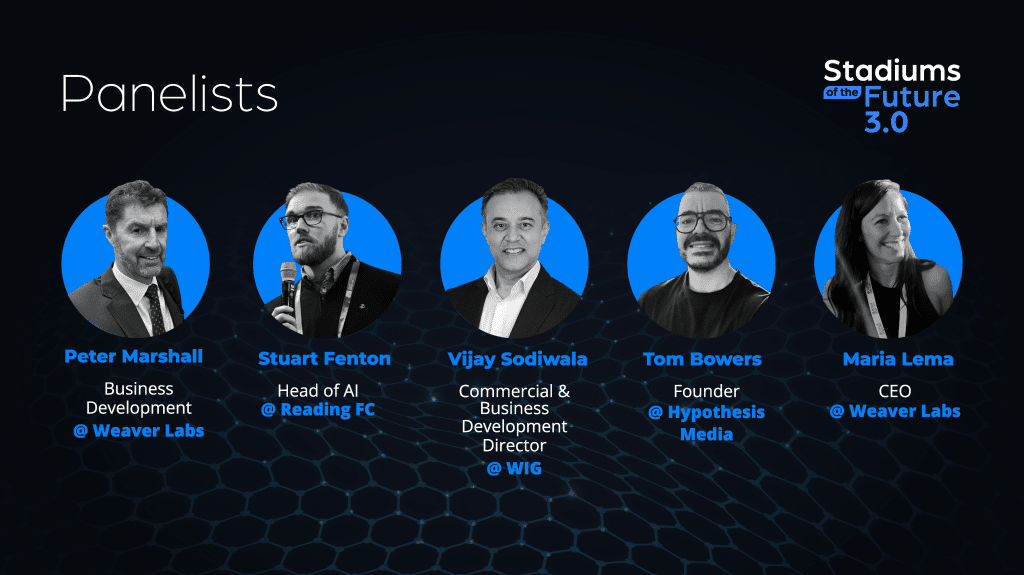
Led by Peter Marshall (Business Development, Weaver Labs), our panel brought together experts spanning AI, telecoms infrastructure, live media, and cloud orchestration:
If you missed the live session, here are the core themes and key highlights from the discussion.
1. The Dynamic Fanbase: Tailoring the Experience Across Generations
Stuart Fenton kicked off the panel by addressing how the modern sports spectator is evolving. Venues must cater to three distinct fan personas concurrently:
The Terrace Generation: Legacy fans who cherish traditional matchday rituals, physical programs, and the classic stadium walk.
The Streaming Generation: On-demand fans who consume sport 24/7, following specific players, fantasy stats, and content across devices.
The AI-Native Generation: Future spectators who treat instant, high-bandwidth connectivity and personalized digital interactions not as novelty features, but as a baseline expectation.
2. Infrastructure First: Connecting People and Places at Scale
Delivering meaningful and rich digital experiences requires a dedicated mobile connectivity solution that is built to handle the high capacity demands from fans visiting a stadium. Vijay Sodiwala outlined how high-footfall, high-density environments such as stadiums and arenas experience high usage peaks at key points during an event. In football stadiums this is typically at the beginning, half-time and end of a match – known as the double “bathtub profile”.
To ensure stadiums can provide the best possible mobile connectivity, clubs and stadium operators should be focusing investment in future-proofed mobile infrastructure solutions that provide:
Full-Stadium Coverage: Addressing the entire fan journey from ticketing, turnstiles and concessions through to hospitality and VIP suites, not just the seating bowl.
Multi-Operator Capability: Supporting all carriers/mobile operators so every fan gets the same high quality mobile service.
Modularity & Flexibility: Making stadiums ready for fans today but seamlessly capable of being adapted to the future needs of the club and mobile operators.
3. Real-Time Content: Turning Mobile Screens into Engagement Hooks
Tom Bowers illustrated how venues can tap into the tech fans bring in their pockets. Modern fan engagement isn’t just about static post-match updates; it’s about making live moments interactive in real time.
Through real-time visual tools -ranging from interactive fan cams and live polling to instant multi-angle streams- venues can elevate pre-match and halftime energy while unlocking new commercial sponsorship models. Crucially, digital engagement extends beyond local attendees to include global fanbases seeking a direct connection to the live event.
4. The Digital Layer: Orchestration via Cell-Stack
Closing the panel, Maria Lema explained how software bridges the gap between hardware infrastructure and fan-facing applications.
Through Weaver Labs’ Cell-Stack software orchestration platform, venues gain full control over their digital domain:
Edge Cloud Execution: Low-latency tasks (such as multi-angle video routing or real-time AI computer vision) run locally on-site, while cloud-friendly applications tap into remote resources smoothly.
Commercial Monetisation: By taking control of the software layer, venues transform connectivity from a silent overhead cost into an active revenue engine through B2B partnerships, targeted sponsorships, and bespoke fan services.
Summary Panel Takeaways
To conclude the session, host Peter Marshall asked each panelist to share their primary message in a few words:
Maria Lema: Modern fan experiences require tight integration between the physical network and cloud-native software layers.
Stuart Fenton: Engage your fanbase early to make digital transformation a shared journey.
Vijay Solu: Viewing the stadium as an active digital asset opens up untapped commercial opportunities year-round.
Tom Bowers: Leverage interactive tools to reward fan loyalty and create unforgettable moments.
Peter Marshall: A stadium of the future is like a blue cheesecake; it requires a solid foundation, smart middle orchestration, and rich top-level insights.
Sports venues often struggle with advanced digital applications because rigid, legacy network hardware cannot handle peak fan demand. To solve this, stadiums must adopt an open, software-defined network infrastructure that seamlessly integrates fragmented data silos. By transforming connectivity into agile digital real estate, venues can unlock greater operational efficiency, data sovereignty, and significant new revenue […]
The live entertainment industry has reached a point where the physical experience on the field or stage is only half the story. The other half happens in another reality that is becoming embedded in everything we do –the screens in the palm of every spectator’s hand. Fans expect to interact with the event –whether that […]
This article marks the conclusion of our series on the digital evolution of modern venues where we shift from identifying the problem to executing the solution. If our previous articles established that technology is no longer a utility but a strategic asset, and that infrastructure is the engine of ROI, this final piece outlines the […]
In the second part of our three-part series, we move beyond connectivity as an asset to explore the ‘Translation Gap’; the critical divide between collecting stadium data and converting it into commercial fuel. In our previous discussion, we addressed the “Shiny Object” trap; the tendency to prioritise high-tier applications over the foundational infrastructure required to […]
This is the first in a three-part series exploring why connectivity has evolved from a back-office utility into a stadium’s most powerful commercial engine. In the modern sports and entertainment landscape, the pursuit of innovation is relentless. Stadium operators are under immense pressure to deliver the “stadium of the future,” leading to significant investments in […]
At Weaver Labs, we believe a truly smart stadium isn’t defined by cables, antennas, or signal bars; it’s defined by what connectivity enables. A smart venue is one where digital infrastructure acts as a platform, allowing immersive experiences, real-time interaction, and innovative ways for fans to engage with the matchday experience. On February 17th, we […]