London, December 5, 2023 — Weaver Labs, in collaboration with CIN, Colt Technology Services, Radisys, Benetel, and D-Link, is proud to announce the successful demonstration of a revolutionary 5G OpenRAN Fixed Wireless Access (FWA) network in a dense urban area. This innovative project showcases an alternative approach to providing indoor connectivity, using cutting-edge technologies and strategic partnerships.
In this groundbreaking trial, Weaver Labs has deployed an edge-cloud-based OpenRAN 5G private network, powered by Radisys and Benetel technology. Colt incubated these pilot activities as part of its Smart Solutions program in operation since June 2022. The pilot includes in-house solutions for Backhaul, Fronthaul and 5G Synchronization based on the Colt IQ Network, to support a variety of use cases. Utilising D-Link’s Fixed Wireless Access solution, the network extends its reach to surrounding businesses and homes, becoming a valuable resource for the entire community.
Key Highlights of the Project:
Weaver Labs, in a strategic move towards revolutionising indoor connectivity in dense urban landscapes, has established formidable partnerships with industry frontrunners CIN, Colt, Radisys, Benetel, and D-Link. This collaborative effort aims to deliver an all-encompassing solution that addresses the intricate challenges of indoor connectivity.
This innovative approach for Colt of utilizing Private 5G for fixed wireless access presents a valuable addition to our future product portfolio, particularly for providing resiliency, reaching complicated or isolated sites and will perfectly complement other access technologies of our standard portfolio: fibre, standard FWA based on cellular and satellite.
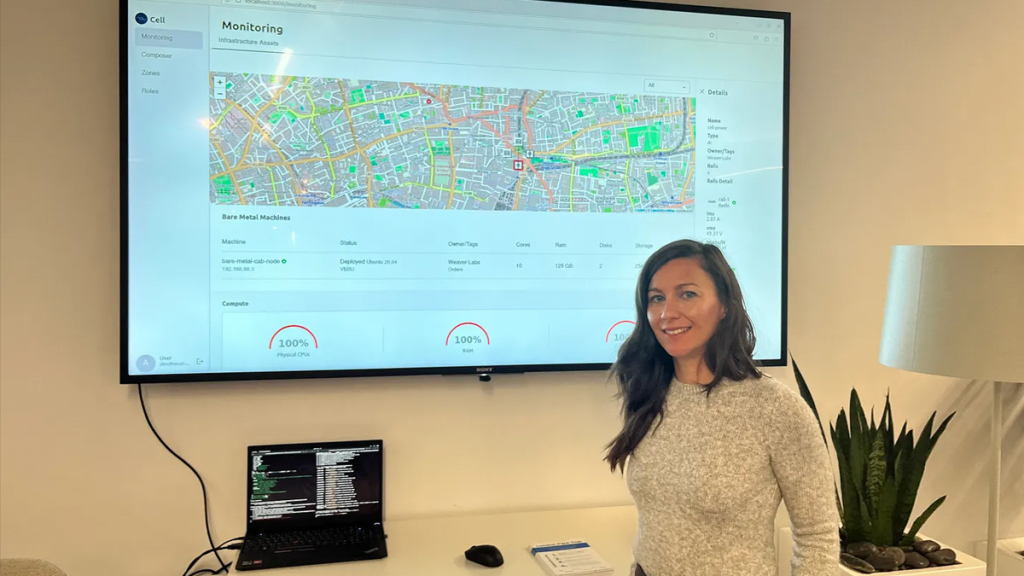
At the heart of this groundbreaking initiative lies Weaver Labs’ Cell-Stack, functioning as the central hub for the automated deployment, runtime management and monitoring of the solution. This innovative tool streamlines infrastructure management, orchestrates both bare-metal and virtual networks, and efficiently handles power management tasks. Software-based network deployment and management cuts operational costs and makes this solution easily replicable and scalable.
Notably, the project places considerable emphasis on OpenRAN technology, showcasing its potential to redefine indoor connectivity in densely populated urban areas, all while requiring a fraction of the investment compared to traditional fibre solutions.
The London FWA Trial Results also include the following:
Coverage and Network Planning: The project collaborated with Wisdm, a coverage and network planning tool, to demonstrate remarkable performance differences between the allowed transmit power in shared spectrum license (24dBm) and the new proposed license (27dBm). Results show that with just a 3dB increase in dense urban areas, the number of addresses reached almost doubles, impacting the economic case. Interestingly, increasing transmit power to 30dBm or 33dBm showed similar results and conclusions than 27dBm, with just a marginal increase over the number of addresses covered. This is due to the density of the environment in Shoreditch as well as the height of the antenna in CIN’s Street Arc solution.
Economic Viability: The economic case results highlight FWA as a viable solution in dense urban areas only when transmit power is over 27dBm. This makes a strong case for the recent Ofcom consultation regarding the increase of 3dB in transmit power for the shared spectrum license. The rise of private networks, coupled with the cost savings from software-based solutions, makes this coupled solution an attractive option for outdoor to indoor coverage in areas where civil works are needed to get fibre to the home.
This project marks a significant step forward in the development of Cell-Stack to support open architectures like 5G OpenRAN, setting new standards for connectivity solutions in urban environments.