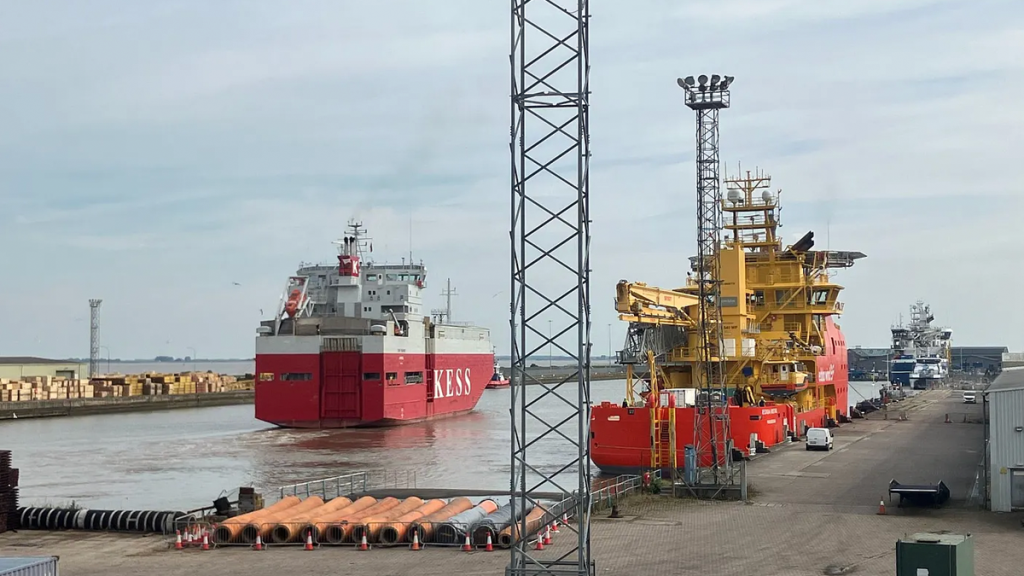
Walk into any port at dawn and the scene looks seamless: cranes in motion, forklifts in formation, vessels coming and going with clinical precision. But talk to those running operations and a different picture emerges: paper-based workflows, radio comms that drop off mid-task, and networks that go dark at the site’s edges.
Ports are critical hubs of economic activity, yet most still operate on outdated connectivity. Behind the scenes, systems struggle to sync. Devices don’t talk to each other. And critical tasks like safety inspections, cargo tracking, or equipment monitoring are still handled manually or with siloed tools.
The Real Problem?
Connectivity in ports is unreliable, fragmented, and completely out of step with the complexity and scale of modern operations. But this isn’t just a technical limitation, it’s a lost opportunity. Poor connectivity drags down productivity, increases safety risks, and leaves value on the table.
Modernising port infrastructure with 5G and digital applications should be a game-changer. But despite the promise, deploying this tech is often prohibitively expensive, inflexible, and out of reach for many port operators. The reason? Control lies almost entirely with traditional telecoms.
Currently, telcos hold the keys to the network, from the infrastructure build to management and monetisation. Ports are essentially locked into models dictated by Mobile Network Operators (MNOs), with little room to tailor solutions to their operational needs. Even more limiting is spectrum access. Valuable spectrum bands, essential for running private 5G networks, are tightly controlled and licensed to MNOs, making independent management by ports or logistics hubs nearly impossible.
What if ports could take ownership? What if they could build and run their own network, on their own terms, and use it to both improve operations and create new revenue streams?
Weaver Labs bringing opportunities to Ports
We’ve developed two powerful technologies that change the rules of the game: Cell-Stack and Cell-Mesh.
We built Cell-Stack to flip the telecom model on its head. Instead of relying on legacy operators, Cell-Stack gives infrastructure owners like port authorities and operators the software to run and monetise their own network infrastructure.
Cell-Stack is an orchestration platform that lets you:
- Orchestrate and automate your own infrastructure and 5G network
- Connect and manage devices and services across a single platform
- Host intelligent applications in real time
- Offer network access to tenants, partners, or service providers on demand
While Cell-Stack gives ports the ability to orchestrate and control private 5G networks, Cell-Mesh brings a powerful new dimension: dynamic, decentralised connectivity that breaks down communication silos across port operations.
Cell-Mesh is Weaver Labs’ other flagship innovation, a peer-to-peer messaging and data transmission solution designed to connect fragmented infrastructure across any area. It enables seamless communication and data sharing between stakeholders, like customs, logistics providers, and maintenance crews, even in areas with limited or no central connectivity.
Unlike traditional systems, Cell-Mesh doesn’t rely solely on the internet. Instead, it enables messages and data to be relayed across devices until they reach a connection point, whether via 4G, satellite, or Wi-Fi, ensuring continuity of operations, even in adverse or disconnected environments.
These tools aren’t just products, they’re an entirely new approach to building and operating network infrastructure, based on our Network-as-a-Service (NaaS) model.
What Can Ports Actually Do with Cell-Stack & Cell-Mesh?
Cell-Stack & Cell-Mesh makes it possible to launch real-time, data-driven applications that were previously impossible due to poor or non-existent connectivity. Here are just a few ways it’s already transforming port operations:
- AI-Powered Shipment Monitoring: Using AI + video streaming, shipment data can be captured, validated, and shared in real-time. That means better traceability, improved inventory accuracy, and faster turnaround times.
- Drone-Based Inspections: For ports near wind farms or critical infrastructure, inspection is constant. With Cell-Stack enabling low-latency connectivity across the entire site, autonomous drones can perform real-time monitoring improving safety, reducing downtime, and slashing maintenance costs.
- Connected Worker & Safety Applications: From location tracking to fatigue detection and emergency alerts, Cell-Stack supports next-gen worker safety systems by providing the real-time network backbone they need to operate smoothly.
- Flexible Site-Wide WiFi & IoT Enablement: Enable tailored connectivity across different parts of the port: warehouses, docks, parking areas ensuring devices and people stay connected, wherever they are.
- Tenancy Models & Monetisation: Ports can now offer network access as a service, for example, allowing logistics companies or maintenance partners to plug into a secure slice of the private network to run their own applications or devices.
- Cold Chain Compliance for Perishable Cargo: Just like in the agri-food industry, Cell-Mesh allows real-time applications, monitoring of temperature-sensitive cargo like seafood, vaccines, or chemicals while they’re stored or moved across the port. Alerts are triggered if thresholds are breached, helping prevent spoilage and ensuring regulatory compliance.
- Insurance & Claims Automation in Port Logistics: Enables secure and instant communication between port operators, insurers, and cargo owners. Real-time environmental data and event logs support proactive risk mitigation and faster claims resolution in case of damage or delays.
- Predictive Maintenance for Port Equipment: Borrowing from Industry 4.0 applications, Cell-Mesh supports machine-to-machine communication among cranes, forklifts, and monitoring sensors. This allows predictive maintenance workflows to be executed automatically, reducing unplanned downtime and repair costs.
- Vehicle & Vessel Coordination (V2X at the Port): Enables secure communication between port vehicles, automated gates, and vessels. Real-time data exchange helps optimise gate entry, route planning, and emergency vehicle prioritisation, reducing congestion and improving safety.
- Emergency Resilience & Offline Operations: In the event of network failure or poor connectivity, Cell-Mesh’s peer-to-peer capability ensures that operations, like security communications or inspection updates, can continue, relaying messages until a connection is re-established via satellite, Wi-Fi, or 4G.
These applications are just the beginning. The potential for innovation at ports is virtually limitless. As operations grow more complex and data-driven, these technologies provide a scalable foundation for continuous improvement, automation, and monetisation.
Case Study 1: Grimsby Port — A Live Example
As part of Project ARANA, Weaver Labs partnered with OREC at Grimsby Port to demonstrate the potential of next-generation connectivity in industrial settings. We integrated seamlessly into an existing private 5G network, enhanced with an edge cloud solution, to support real-time applications, fully orchestrated by our network operating system, Cell-Stack. This setup enabled a flexible, multi-tenant environment, allowing secure, real-time operation of new digital services.
The project showcased how ports can break away from legacy infrastructure and accelerate digital transformation. By using decentralised network technologies, ports like Grimsby can take control of their digital futures without relying solely on telecom providers or undertaking massive capital expenditure.
A major highlight of the deployment is the successful integration of four live video feeds across the port over the 5G network using Cell-Stack. These feeds provide continuous monitoring of shipments, enabling precise tracking and real-time situational awareness. Leveraging Cell-Stack’s modular and scalable architecture, the system has significantly improved operational visibility and streamlined logistics workflows. This deployment also lays a strong foundation for future enhancements such as drone surveillance and AI-driven monitoring. Beyond technical performance, the solution has proven economically viable, demonstrating how ports can modernise, and monetise their infrastructure using efficient, Web3-enabled technology.
Case Study 2: Track & Trust project with Cell-Mesh
Cell-Mesh can be seen in action with the Track & Trust project, an initiative supported by the European Space Agency (ESA), in partnership with Datarella and Ororatech. This initiative is transforming supply chain monitoring for humanitarian logistics by using decentralised network sharing and real-time connectivity.
In this project, custom Cell-Mesh devices running the Cell-Mesh software have been placed into supply vehicles delivering shipments as part of an aid project in an area with low connectivity coverage. Some of the devices may also be connected to a satellite communications terminal (provided by OroraTech). Applications developed by Datarella that have been placed on top of the network layer use the Cell-Mesh software to send messages tracking actions and events along the supply route. Each of the devices tracks actions and events of the vehicle in which they’ve been placed. When devices are within range of a 4G cell tower, the messages are sent via 4G to a cloud-based backend.
In areas of poor or no connectivity, messages are stored on the devices for later sending. When the device enters the 4G range once more, it sends any stored messages over 4G. If, however, the device encounters another device before regaining 4G connectivity, it instead transmits stored messages to the other device by utilising Cell-Mesh’s peer-to-peer functionality. In this way, when encountering areas of little or no connectivity, messages can travel over a mesh network until they reach a device that either has a connected satellite communications terminal or regains 4G connectivity; at this point, the device with connectivity can send the received messages to the cloud backend either via satcom or 4G, respectively.
The Future: A New Era of Network Ownership and Value Creation
With Cell-Stack and Cell-Mesh, Weaver Labs is helping ports evolve from connectivity consumers to connectivity providers. This isn’t just digital transformation, it’s a fundamental shift in power and potential.
Ports can now:
- Build and run their own 5G networks
- Enable collaborative, decentralised applications
- Transform compliance, safety, and logistics
- Offer infrastructure-as-a-service to ecosystem partners
- Monetise every layer of their digital environment
As shown through live deployments at Grimsby Port and cross-industry pilots like Track & Trust, the future of port operations is not only more connected, but also more collaborative, intelligent, and profitable.
Ports already have the infrastructure. Now, with Weaver Labs, they can own the network, and the value it creates.